RIREON

Scalable AI content platform for businesses:

Instead of creating SEO-optimized content individually, build an automated content pipeline—complete with briefings, keyword clusters, semantic fields, a 3D model, multilingual support, and WordPress/API export.
What is RIREON?

RIREON isn't a writing app—it's an AI content platform for businesses

Many AI text generators help with writing individual pieces of content. RIREON is designed for businesses and tailored to scale content production: → From topic research and SEO briefings to automated publishing. → You manage content through projects, templates, and quality metrics, rather than manually copying and pasting.

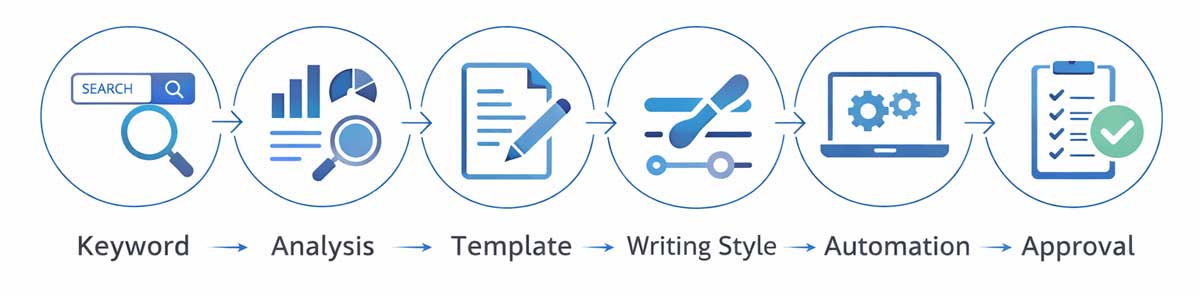
The RIREON Content Pipeline

RIREON Content Pipeline
Who is RIREON suitable for

For agencies, companies, and publishers that treat content as a process

Agencies and SEO teams

Automate the creation of numerous professional landing pages and clusters of SEO-optimized content—without compromising quality and without requiring additional editorial time.

Business (Marketing/SEO)

Publishers and major projects

Here's how it works

How to create scalable SEO content—all in one system

01

Step 1 – Strategy & Data Foundation

RIREON analyzes search intent, competitors, structural patterns, and relevant terms. This results in briefings, word lists, and outline frameworks for each topic or cluster.
02

Step 2 – Production & Quality Control

All content is generated based on specific rules: tone, length, structure, internal linking logic, keyword transitions, readability, and unique words—while automatically being optimized for SEO.
03

Step 3 – Export & Operation

Publish content via WordPress export or API. Updates, enhancements, and rewrites are managed through projects and templates.
What RIREON actually produces

From SEO Text Generator to Content Factory

Landing Pages & Programmatic SEO

(Mass production)

Blog posts & guides with expertise

(Structured Texts)

Technical Texts & Content for a wide range of industries

(Stable, data-driven)

Multilingual websites with localized content

(Multilingual Logic)

Content Updates for Refreshness

(Expand, Refresh)

Modules

The RIREON platform modules:

01

SEO Optimization System

Keyword relevance, WDF*IDF logic, topic clusters, semantic fields, 3-D model, SERP comparison, text length, readability optimization.

02

Competitor Analysis & Structural Patterns

Pattern recognition, topic gaps, text types, topic areas, and text structures—automatically translated into AI briefings.

03

Content Management System & Content Planning

Topic Finder, Keyword Finder, Website Checker, Scheduling, Planning Logic, Cluster Structure, Teams, Roadmap.

04

Multilingual Content Creation

Language-specific briefings, glossaries, and output logic—not just content translations, but genuine local SEO logic.

05

AI Images & Metadata

Image suggestions and generation, including filename/alt text logic (depending on the setup) and appropriate meta structure for landing pages.

06

Integrations (WordPress & API)

Direct export via plugin or API, automations, webhooks, structured output (XML/JSON/HTML/text).

→ AI Text Generator – What makes RIREON different

An AI Text Generator can expand your publishing pace, but speed alone does not win search. Search systems rank pages by relevance, freshness, and reader satisfaction, so an AI Text Generator only works when the copy answers a real need clearly. In practice, pages that solve one precise question tend to hold visibility longer than broad, fuzzy copy. Wider topic coverage can help your site, yet thin pages drain crawl budget and weaken trust. A strong service page may rise because it explains context and evidence. A vague block still slips. Editorial judgment matters more than output volume, and that tension shapes every serious content strategy.

Algorithmic signals and relevance

When you draft with an AI Text Generator, small Algorithmic signals start to matter quickly. Copied wording weakens perceived relevance, while precise language, lived examples, and context-rich phrasing give search systems stronger reasons to index and rank the page. Speed still helps, but clean editing protects those signals.

AI Text Generator signals

When a text generator keeps spinning near-identical pages, search systems spot the pattern fast. Swapping only names creates canonical clashes, bloats the index, and muddies internal links. Some outputs even diverge just enough to split relevance across similar URLs, which quietly hurts visibility and wastes crawl time. Planning before you scale an ai text generator approach keeps the site coherent.

Planning for AI Content Strategy

When you plan an AI content approach, speed and risk sit side by side. A clear priority list shows where automation earns time and where your judgment needs to stay close. An AI text generator supports volume, but reliable SEO still starts with briefs that define intent, format, source needs, and proof standards. Without that frame, duplicate pages appear because the model fills gaps without a real angle. Product updates often tolerate faster drafting. Advisory pages usually need tighter human AI collaboration. More pages do not create authority; sharper curatorial decisions do. That difference often saves rework, legal review time, and missed ranking opportunities.

Tool selection criteria

When you compare a tool, tone control and consistency matter as much as price. A GPT chat or API setup lets your team test prompts inside a real workflow, not a demo. Editorial teams usually define selection criteria around brand voice, compliance, review time, and the cost of fixing weak drafts later.
  • Consistent brand voice
  • Real-workflow prompt testing
  • Faster editorial reviews
  • Lower revision costs
  • Compliance risk reduction

→ What makes RIREON so special

Editorial Cost-Benefit Maps

Editorial Cost-Benefit Maps show which formats deserve deeper editing and which move faster. A short support article often needs light cleanup, while a comparison piece needs careful fact checks, context, and sourcing. Pricing editorial work around hours instead of word count gives your strategy a more honest budget and steadier output.

Preparation for Workflow Integration

Once the strategy feels settled, the daily editorial workflow decides whether the system holds together. An AI text generator works best when each person knows the task, the review scope, and the handoff time. A tight brief keeps intent clear, writers stay on track, editors protect tone, and legal reviewers catch risks before publication. Shared ownership prevents prompt tweaks from creating random voice shifts across your site. In many teams, a draft moves from brief to SEO assessment and then to compliance within a single afternoon. Having stable roles turns generation from isolated output into a repeatable operating system. Templates and platform rules keep the pipeline predictable.

Pipeline steps and checkpoints

A solid brief sets intent, source needs, and format before the pipeline starts. Then the generator drafts the page, editors tighten structure, verify facts, and refine seo alignment. Legal reviewers confirm compliance and timing. Clear checkpoints cut missed errors, and they stop small prompt changes from breaking the process.
  • Briefing intent and scope
  • Drafting initial page content
  • Editing structure and facts
  • Legal compliance and timing
  • Checkpoint validation and control

Prompt templates and quality checks

Useful prompt templates give the model enough context to stay steady and specific. Your review loop should check originality, factual accuracy, readability, and brand fit during quality checks. That simple habit matters. Without it, rankings may reflect luck rather than dependable content quality.

Execution: Testing and Measurement

Thoughtful Testing shows where automation earns its place and where it starts to bluff. Reader behavior and search metrics together tell you whether a draft lifts rankings, engagement, or neither. Fair comparisons need similar topics, matched publish dates, and the same search intent. In a B2B software blog, matched article sets showed 30% more scroll depth for AI-assisted drafts, but traffic quality and internal link paths explained whether that lift mattered. What does extra traffic buy if visitors leave after eight seconds? Evidence beats enthusiasm here. An evidence-based approach to Measurement protects budgets from shiny claims about scale.

Benchmarking AI versus human content

When you compare equal briefs across similar topics and matched windows, ranking movement becomes easier to read. One page set uses an AI text generator, another relies on human content creators, and the analysis tracks SERP change, dwell time, conversions, update effort, and simple heatmap signals that expose reader hesitation.

Reader Trust Heatmaps

On a page, trust heatmaps show where readers pause, click, or leave, and that detail matters. Scroll depth and click patterns reveal whether a draft feels thin or useful. Short surveys add context analytics miss about an ai text generator voice. This creates blind spots. Together, these signals protect reader trust and support visibility.

Maintenance: Quality, Compliance, and Governance

Lasting performance depends less on speed and more on disciplined maintenance over time. Regular audits catch stale facts, duplicated intent, weak evidence, and policy gaps before rankings slip. Clear editorial roles support Quality control as the site grows. If your content generation software scales output across regions, local review becomes essential. Strong Governance keeps translation nuance, privacy standards, and approval trails intact.

Ongoing quality metrics

A practical set of quality metrics tracks accuracy, freshness, tone, and performance drift. Sampling published pages each month shows when an AI Text Generator starts sounding generic or dated. Clear thresholds tell your team when to revise, merge, or remove weak pages. That discipline reduces avoidable publishing risk and protects hard-won visibility.
  • Monthly page sampling
  • Quality metric tracking
  • Threshold-based flags
  • Revision and consolidation actions
  • Visibility protection monitoring
Getting Started with RIREON

How companies get started with RIREON

1. Inquiry & Initial Consultation

We clarify objectives, content volume, and technical requirements—in a structured manner and with no obligation.

2. System Analysis and Demo

We demonstrate how RIREON is applied in practice to content, markets, and processes—real-world workflows.

3. Setting up the content pipeline

Together, we define the structure, automation, and integrations. The system is precisely tailored to your needs.

4. Go-Live and Optimization

Once the system is up and running, we monitor its operation and optimize output, scalability, and quality.

Who We Are

RIREON – A platform for scalable content infrastructure

RIREON is a technical platform for automated, data-driven content production. The system was developed to plan, generate, and manage large volumes of SEO-relevant content in a structured manner—fully pipeline-ready and multilingual. The focus is not on individual texts, but on reproducible content systems that support companies in their growth.